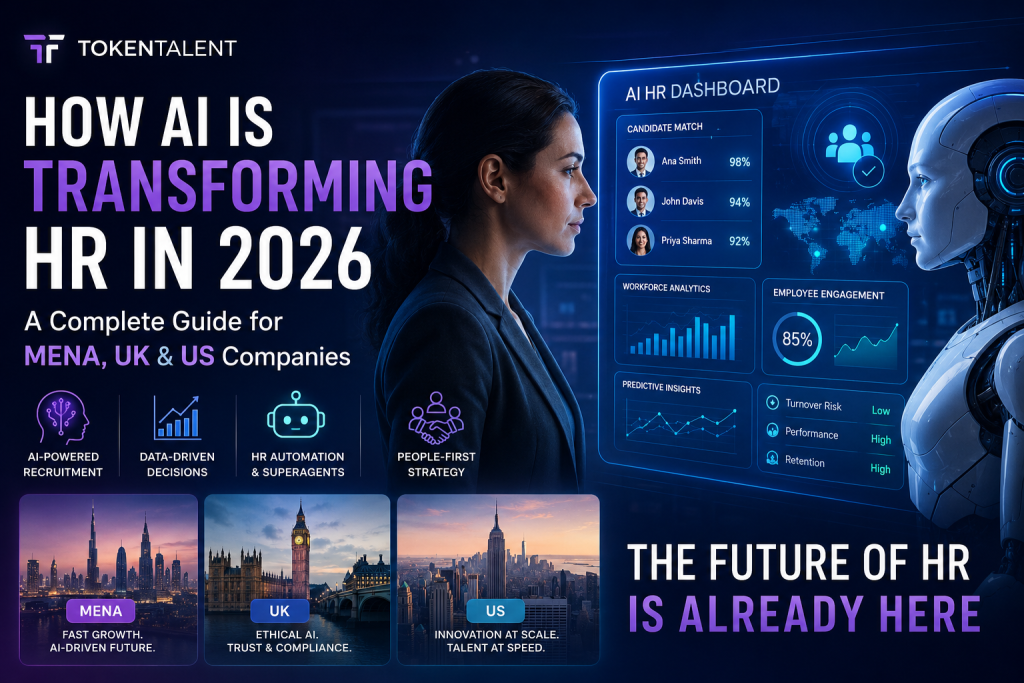
How AI is Transforming HR in 2026: The Ultimate Guide for MENA, UK & US Companies
In 2026, HR is no longer a support function—it’s a data-driven growth engine powered by AI.
From automated hiring pipelines to predictive workforce analytics, AI is transforming how companies attract, manage, and retain talent across MENA, the UK, and the US.
And here’s the reality:
👉 Companies that adopt AI in HR today will dominate talent markets tomorrow.
👉 Those who don’t? They’ll struggle to compete.
According to recent research, AI is already embedded in core HR functions like recruitment, performance management, and workforce planning
AI is Replacing Traditional Recruitment (Faster Than You Think)
AI has completely reshaped recruitment in 2026.
- Automated CV screening
- AI-driven candidate matching
- Smart interview scheduling
- Predictive hiring success scoring
In fact, high-volume recruiting is now AI-first, reducing hiring time dramatically .
What this means for companies:
- Hire faster than competitors
- Reduce cost-per-hire
- Eliminate human bias (when done right)
MENA Insight:
Governments and enterprises are investing heavily in AI talent pipelines—especially in UAE & Saudi Arabia.
UK & US Insight:
Companies are scaling AI hiring—but candidates are demanding more human touch in the process.
AI is Becoming the Brain of HR Decision-Making
Forget gut decisions—AI is turning HR into a predictive science.
Modern HR teams now use AI to:
- Predict employee turnover
- Identify top performers early
- Optimize workforce planning
- Analyze engagement in real-time
This shift is critical because HR is moving from reactive to predictive decision-making.
👉 Companies using AI insights outperform competitors in retention and productivity.
AI Superagents Are Automating Entire HR Functions
One of the biggest 2026 breakthroughs?
👉 AI “superagents”
These systems can:
- Handle onboarding
- Manage employee queries
- Run performance reviews
- Deliver personalized training
Experts predict AI could automate a significant portion of HR workflows, redefining HR roles entirely
The shift:
Old HR → Administrative
New HR → Strategic + AI-driven
4. The Rise of the “People-First AI” Strategy
Here’s the twist:
AI alone is not enough.
👉 Companies that win in 2026 use people-first AI strategies
This means:
- Transparency in AI decisions
- Ethical hiring practices
- Human + AI collaboration
- Trust-first workplace culture
Because AI without trust fails .
5. The Global Divide: MENA vs UK vs US
🇦🇪 MENA (Fast Growth, Government-Driven)
- Rapid AI adoption
- Smart city + workforce initiatives
- Talent shortages driving AI hiring tools
🇬🇧 UK (Regulated, Cautious Adoption)
- Strong focus on compliance & ethics
- Rising concerns about AI hiring fairness
- Increasing legal frameworks
🇺🇸 US (Innovation at Scale)
- Fastest AI experimentation
- Heavy investment in HR tech
- Competitive talent market driving automation
6. The Hidden Risks of AI in HR (No One Talks About)
AI isn’t perfect.
Companies are facing:
- Bias in algorithms
- Lack of transparency
- Candidate distrust
- Over-automation risks
Some candidates even report AI hiring processes feel impersonal and ineffective .
👉 The takeaway: AI must enhance—not replace—human judgment.
7. The Future of HR Jobs: Evolve or Become Obsolete
AI is not replacing HR—it’s transforming it.
New HR roles emerging:
- AI HR Strategist
- People Analytics Specialist
- HR Automation Architect
- Employee Experience Designer
Meanwhile:
👉 Traditional admin-heavy HR roles are declining.
Conclusion: The AI-HR Revolution is Already Here
2026 is the tipping point.
AI is no longer optional—it’s a competitive advantage.
Companies that:
✔ Adopt AI early
✔ Balance tech with human experience
✔ Build trust-first HR systems
…will win the talent war.
Ready to future-proof your HR strategy?
👉 Visit Tokentalent.co to:
- Access AI-powered talent solutions
- Hire faster across MENA, UK & US
- Build a future-ready workforce